
For families considering an international school in Jakarta, the question of what happens after primary years has become considerably simpler. ISJ is expanding to a full through-school, offering GCSEs and A-Levels via the English National Curriculum. Families who want to complete the entire British qualification pathway on campus in Jakarta can now do so. And for those whose postings may take them elsewhere, a well-structured British preparatory education continues to be one of the most portable academic foundations a child can carry.

ISJ as a Through-School: GCSEs and A-Levels in Jakarta
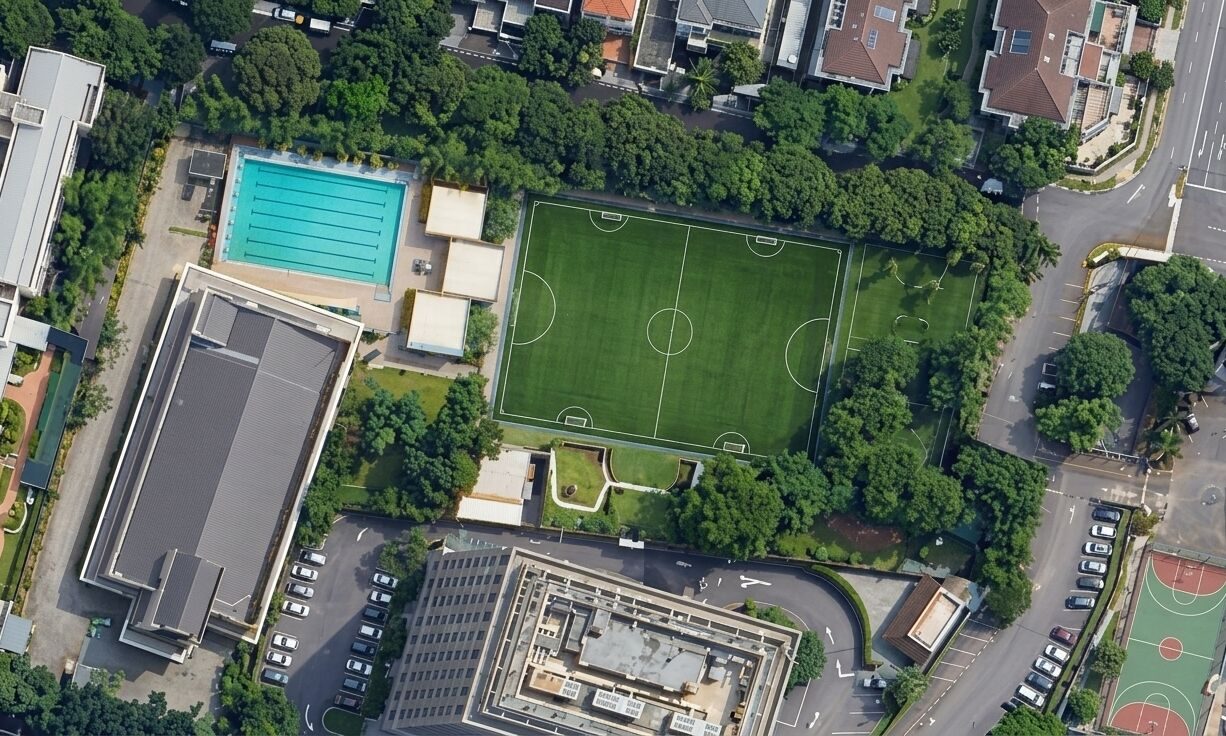
ISJ is opening a new campus to accommodate its senior school expansion. This makes ISJ the only school in Jakarta offering the complete British qualification pathway: English National Curriculum through EYFS, Key Stages 1 to 3, GCSEs, and A-Levels, all in one place. No other school in South Jakarta currently offers this. BSJ uses the IB throughout its secondary programme. ACG Jakarta offers IGCSEs but pivots to IB for Sixth Form and does not offer A-Levels. Wellington College Jakarta opens in August 2026 but begins with ages 3 to 8 only, with secondary years still years away.
For families who want the recognised British qualification route, the choice in Jakarta is straightforward. A pupil who joins ISJ in Nursery can, if the family stays, sit GCSEs and A-Levels on the same campus without ever changing school or switching curriculum. That continuity, from a child's earliest years through to university application, is new in Jakarta.
Relocating at Year 8
Not every family will stay in Jakarta through secondary. For those whose postings take them elsewhere, the British preparatory model remains a strong foundation. The British curriculum is taught in more than 160 countries, and its structure, EYFS into Key Stages, assessment frameworks, and subject progression, is recognised instantly by senior schools in the UK, Singapore, Australia, and beyond.
A child leaving ISJ at the end of Year 8 steps into Year 9 in the UK with no curriculum mismatch. The conceptual sequence in English, mathematics, and science mirrors exactly what UK independent senior schools expect at 13+ entry. There is no remediation period, no catching up, no adjustment to unfamiliar frameworks. The transition is a continuation, not a reset.
This alignment extends to other systems. IB MYP schools expect pupils entering Years 3 and 4 to have secure disciplinary foundations in literacy, numeracy, and science. US Grade 9 requires algebraic reasoning and reading fluency, both central to Key Stage 3. Australian Year 8 and 9 entry aligns closely with the British curriculum in mathematics and science. Families who move to these systems consistently report that ISJ pupils settle quickly and rarely experience the placement difficulties that follow curriculum switches elsewhere.
What the Assessment Data Shows
ISJ uses GL Education standardised assessments, the same benchmarking tool used by leading British preparatory schools worldwide. The mean scores across ISJ pupils are 122 in English, 118.7 in mathematics, and 119.7 in science. The international norm is approximately 100 across all subjects. GL scores between 115 and 120 are typically associated with academically strong UK preparatory schools, many of which feed into selective senior schools at 13+. ISJ's position in, and in English above, that range reflects the teaching quality operating across the school.
For families navigating transitions, these figures carry practical weight. Unlike internal grades, which vary in meaning across countries, GL scores are globally normed. Senior schools, whether in the UK, Singapore, or elsewhere, can interpret them directly. They provide receiving schools with clear, external evidence of academic readiness, which reduces uncertainty during placement decisions.
The British Preparatory Tradition
The British prep school tradition exists for a reason. By the end of Year 8, pupils who have been well taught are ready for deeper subject specialisation: they can analyse a text, construct an argument, work through multi-step mathematical problems, and conduct scientific enquiry with discipline. These are not exam tricks; they are thinking habits that transfer.
ISJ's teaching body is entirely UK-qualified and drawn from British independent and international schools. This shapes lesson design, subject expertise, behaviour expectations, and pastoral routines. The calm, orderly classroom that research consistently identifies as the strongest predictor of learning is not incidental; it is the product of deliberate staffing decisions.
Supporting Families Through the Decision
Senior school readiness is not only an academic question. Families face real logistical complexity: calendar differences between UK, Australian, and Indonesian school years; the question of whether to exit at Year 6, Year 7, or Year 8; how to prepare for entrance assessments without narrowing a child's education; and how to interpret reports across different national systems.
ISJ works with families individually through this process: curriculum mapping, advice on transition timing, reference documentation, and context on how GL data will be interpreted by receiving schools. The aim is clarity, whether the answer is staying in Jakarta through A-Levels or exiting at Year 8 for a UK boarding school. Families researching ISJ's senior years can find the subject offer, A-Level options, and new campus details on the senior school page.
Senior pathways differ sharply between Jakarta's schools, and the differences start well before Year 9.
Common Questions
How well do ISJ pupils transition into UK senior schools?
ISJ follows the same Key Stage structure, progression frameworks, and academic expectations used in British preparatory schools. Senior schools in the UK recognise the curriculum and understand GL standardised scores. ISJ pupils benchmark in the top range internationally, which gives receiving schools clear evidence of readiness.
Can ISJ pupils join IB, American, or Australian systems?
Yes. The British curriculum's conceptual sequence aligns closely with IB MYP entry, US Grade 8 to 9, and Australian Year 8 to 9. Strong foundations in mathematics, science, and literacy reduce the adjustment period that many internationally mobile pupils experience when changing systems.
Is ISJ still a good choice if the family might relocate at Year 8?
Yes. Families who leave at Year 8 benefit from the same curriculum coherence and benchmark data as those who stay. The British preparatory model was designed around a transition at 13+, and ISJ's preparation aligns with that architecture. Pupils who leave carry externally verified assessment evidence and strong academic foundations.
What makes ISJ different now that it offers GCSEs and A-Levels?
ISJ is the only school in Jakarta offering the complete British qualification pathway: GCSEs and A-Levels via the English National Curriculum. BSJ uses IB for its secondary years. ACG offers IGCSEs but not A-Levels. Wellington College Jakarta will not have secondary for several years. Families who want the recognised British route, from early years through to university application, now have that option without leaving Jakarta.
Do ISJ's GL assessment scores help with senior school entry?
They do. GL scores are globally normed, which means receiving schools worldwide can interpret them directly. ISJ's mean scores of 122 in English, 118.7 in mathematics, and 119.7 in science align with the upper range of UK preparatory schools. Senior schools value this because it provides statistically normed evidence of attainment, not just internal grades.
How does ISJ prepare pupils for senior school socially, not just academically?
Small tutor groups mean pupils are closely known by teachers. Pastoral routines, public speaking, drama, competitive sport, outdoor education, and structured co-curricular activity all contribute to the confidence and social maturity that selective senior schools look for at interview and entry. OECD studies link structured extracurricular involvement with higher resilience and better transitions.
Will a child lose ground when moving between systems?
Rarely. ISJ uses externally benchmarked assessments alongside its curriculum, so receiving schools can place pupils accurately. Most transitions result in lateral movement into the equivalent year group, not repetition. Curriculum continuity across the British international network means there is no structural gap between ISJ and the next school.
At what point should a family decide whether to stay through A-Levels or exit at Year 8?
There is no single answer. ISJ works with families individually to map out the timing that suits their circumstances, including posting length, the child's academic profile, and senior school preferences. The key is clarity early: families with a defined plan transition more smoothly than those making last-minute decisions.