

At ISJ, academic excellence is measured not only by final outcomes but by tracking growth. GL Assessments document pupil progress from Year 3 through Year 8.
The GL Assessment Framework
GL Assessments provide internationally recognised measures of ability and attainment, allowing direct comparison with leading UK independent and international schools. ISJ uses four key assessments: the Cognitive Abilities Test (CAT4) measuring verbal, non-verbal, quantitative, and spatial reasoning; Progress Test in Maths (PTM); Progress Test in English (PTE); and Progress Test in Science (PTS).
These are administered at set points through the year to track individual growth, inform teaching, and benchmark against global standards.
The Evidence
Many ISJ pupils begin with scores close to the UK national average of 100 SAS. Through a structured curriculum and targeted interventions, pupils demonstrate steady improvement year on year. By Year 8, ISJ pupils perform at levels equal to or exceeding UK independent school benchmarks.
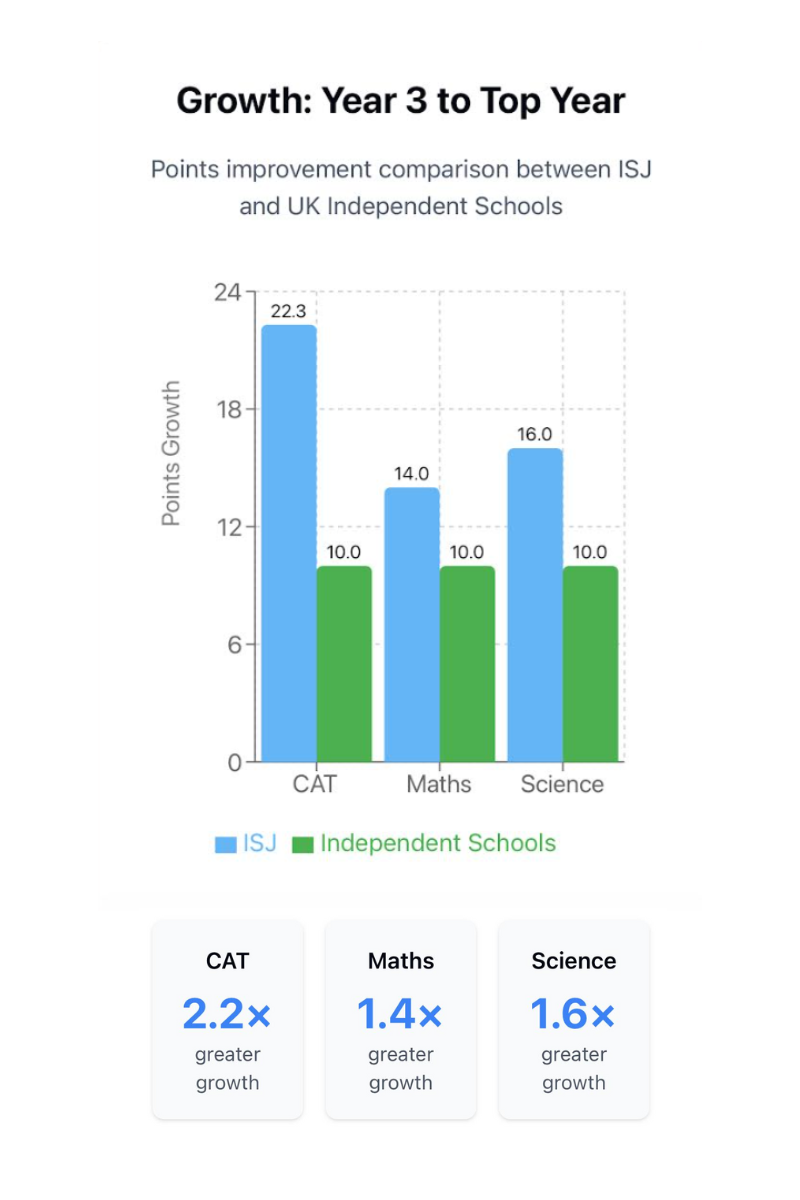
The data shows that pupils improve their CAT4 scores by an average of 22 points between Year 3 and Year 8. Mathematics assessments show particularly strong growth, with Year 8 PTM scores exceeding UK independent school averages. Science scores demonstrate a similar trajectory, with rapid acceleration in Years 6 to Year 8.
How ISJ Compares
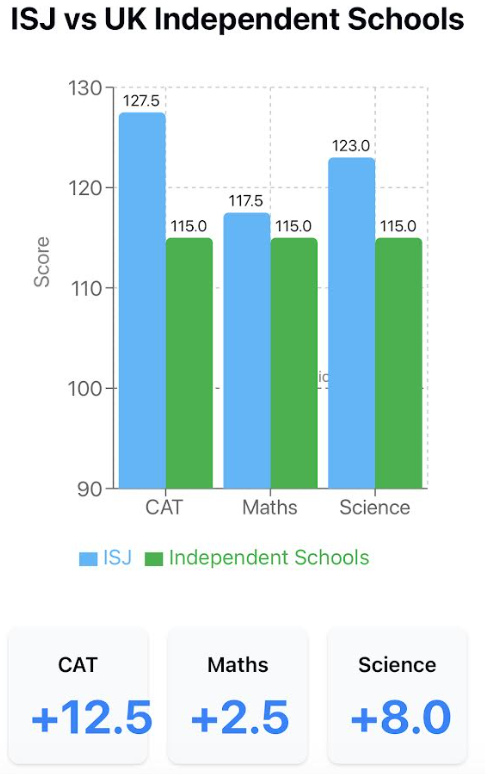
By Year 8, ISJ pupils score above UK independent school averages across all assessment areas. Cognitive ability (CAT4): 120.8 versus the independent school average of 115. The rate of improvement accelerates in Years 6 to Year 8.
ISJ pupils show 2.2 times greater growth in cognitive ability, 1.4 times greater growth in mathematics, and 1.6 times greater growth in science compared to independent school peers.
What This Means
Regular assessment allows teachers to identify each pupil's strengths and areas for development. By Year 8, pupils are prepared for demanding secondary environments in the UK and elsewhere. Further detail on outcomes is on the Results page.