
Outdoor learning in cities is often treated as a problem to be managed rather than an opportunity to be designed. In Jakarta, the instinct to retreat indoors is understandable: the heat, the density, and the traffic create real logistical complexity. The research picture, however, points in a different direction. Children who spend regular time in varied, real-world environments tend to learn more, retain knowledge longer, and develop greater independence. Outdoor learning in an urban setting is an academic priority, not a pastoral bonus.
Why Outdoor Learning Matters in Cities
In dense cities, children's outdoor time has contracted sharply. Apartments limit space, car-dependent commutes replace walking, and leisure increasingly happens in malls rather than parks. Developmental psychologists have documented a reduction in unstructured outdoor play across urban Asia, with consequences for physical health, emotional regulation, and the development of executive functions.
Attention Restoration Theory, developed by Kaplan and Kaplan, identifies varied, non-threatening environments as the mechanism that allows the brain's directed-attention system to recover between focused tasks. Later research clarified that what matters is environmental diversity, not specifically natural landscapes. A shaded courtyard, a garden, a neighbourhood street with changing stimuli: all deliver similar restorative effects. Embodied cognition research adds a second strand. Physical movement in environments that require small adjustments of balance and sensory processing improves recall and deepens conceptual understanding. The city, read correctly, is one of the most educationally dense environments a child can inhabit.
Working With Jakarta, Not Against It
Jakarta presents real constraints: humidity, sudden rainstorms, and periodic air quality fluctuations. Planning accounts for all of them. Morning sessions suit higher-intensity activity; shaded and covered spaces extend learning into midday; air quality thresholds trigger indoor alternatives when needed. Rain need not halt outdoor learning: verandas and gazebos keep observation possible during downpours, and rain itself is productive material, generating measurable data on water flow, drainage patterns, and evaporation rates.
Place-based education research shows that children build stronger conceptual understanding when learning is connected to real environments they can return to over time. Jakarta's varied micro-environments, from kampung lanes to local markets, mangrove edges, and modern transport corridors, provide rich material for geographical enquiry, environmental science, and reflective writing. The constraint is not the city. It is whether the school has designed a curriculum that uses it.
The Campus as a Living Laboratory
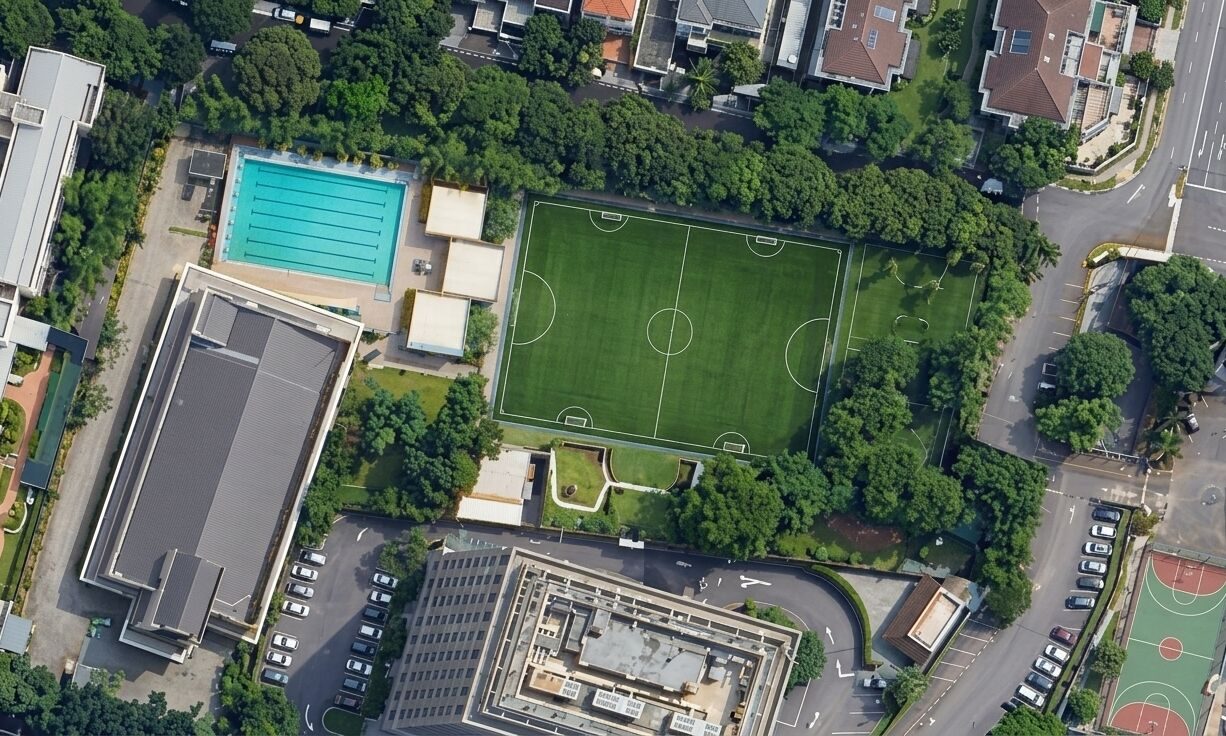
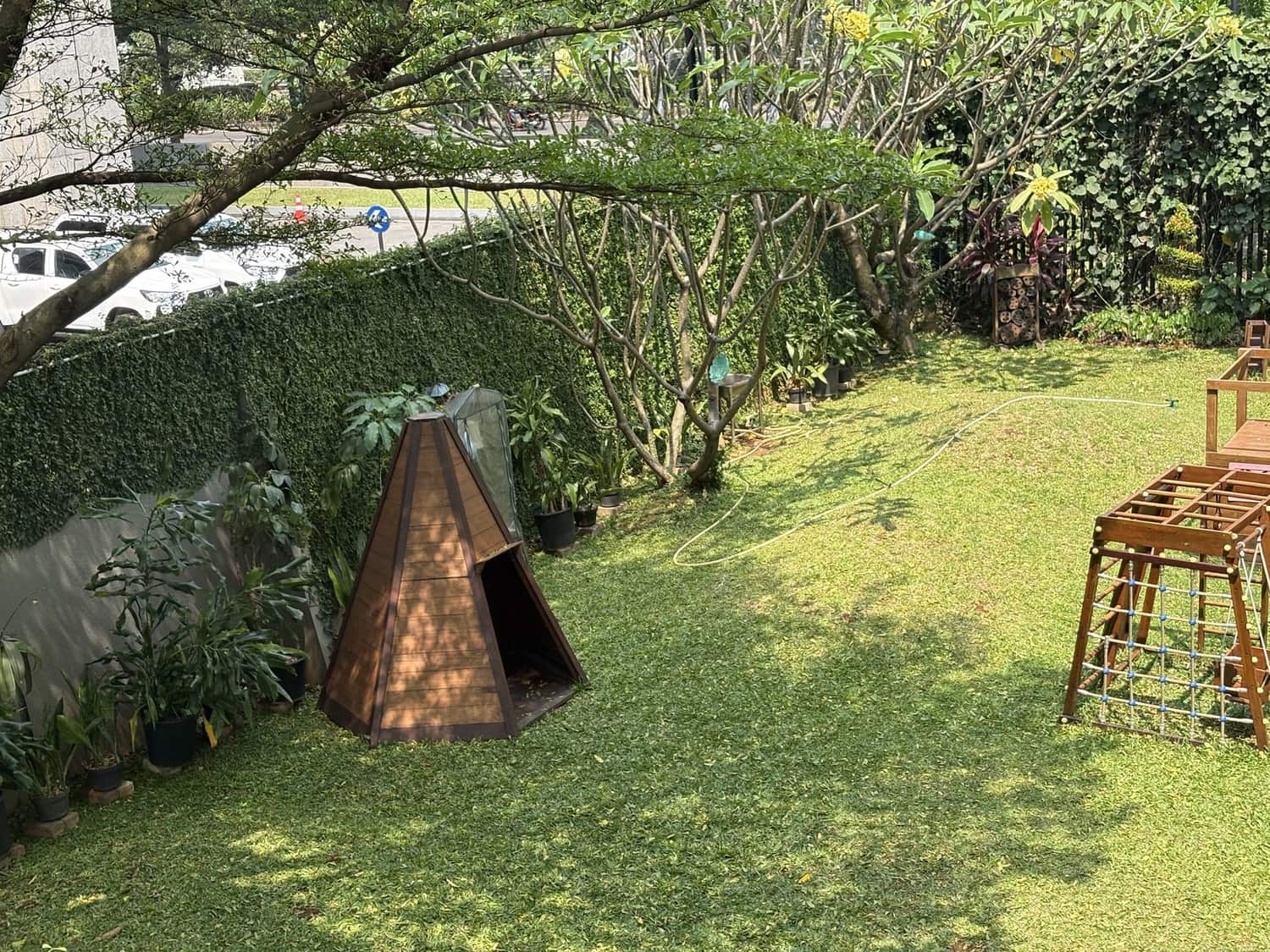
ISJ's campus in South Jakarta is unusually green for the city centre. Mature trees, sheltered courtyards, and planted gardens give pupils daily access to outdoor learning without leaving the grounds. A leafy environment supports attention restoration between lessons, provides micro-ecologies for scientific observation, and allows teachers to weave outdoor learning into the normal school day rather than reserving it for scheduled events.
In Early Years and Primary, the campus gardens function as a field site: ecological surveys, classification tasks, soil comparisons, and sensory explorations at close range. Gardening provides early mathematics through measuring growth, estimating quantities, and interpreting data over time. Forest school pedagogy, defined not by trees but by child-led exploration and managed risk, works equally well in a shaded garden with a mud kitchen or water channel. For older pupils, the same grounds support microclimate analysis, architectural shading studies, and outdoor mathematics using shadow length or temperature variation. Observational writing conducted outdoors often produces more precise language than classroom equivalents, because the sensory detail is present rather than recalled.
Using Jakarta as an Extended Classroom
Short, local excursions extend the academic range beyond the campus. Neighbourhood mapping, traffic observation, plant identification, and architectural sketching can all be structured as curriculum-aligned enquiry. When these sessions happen fortnightly rather than termly, children develop observational habits and fieldwork skills that underpin serious geographical and scientific study.
Longer excursions expand depth. Museums, heritage districts, and science centres provide cultural and historical material. Mangrove forests and riverside edges provide ecological data. Farm visits outside Jakarta are particularly valuable for pupils who have only known urban life: they connect environmental science to food systems and land use in ways that textbook study cannot match. Residential expeditions to the hills and forests of West Java give older pupils structured challenges in hiking, fieldwork, and journalling, academically integrated rather than ancillary, that develop resilience, independence, and leadership alongside subject-specific skills.
Assessment and What Parents Should Look For
Outdoor learning is academically serious only when it is documented, reflected upon, and linked to curriculum objectives. Field journals, labelled diagrams, data tables, and fieldwork reports all serve this function. Over time, these records provide evidence of progress in observational skill, reasoning, inference, and communication. Children who experience structured inquiry cycles repeatedly, questioning, observing, gathering data, reflecting, and presenting, develop habits of mind that transfer into examination subjects.
When evaluating an international school's outdoor programme, facilities are a starting point but not a reliable proxy for quality. The more revealing questions concern frequency, alignment, and documentation: how often do pupils engage outdoors, how are sessions connected to curriculum objectives, and how is risk managed through proportionate risk-benefit thinking rather than simple avoidance? Strong programmes balance regular campus-based sessions with excursions, farm visits, and expeditions. How outdoor learning sits within the broader curriculum is on the curriculum page.
How each campus handles its urban setting is one of the clearer differences between Jakarta's schools.
Common Questions
Why is outdoor learning important for children in a city like Jakarta?
Outdoor learning offsets the indoor-heavy routines common in dense cities. It supports attention restoration, improves cognitive function, and strengthens early scientific and geographical understanding through direct sensory experience that classroom teaching cannot fully replicate.
Can meaningful outdoor learning happen without large natural spaces?
Yes. Research shows that sensory variety, movement, and real-world complexity matter more than size. Even small gardens, courtyards, and local streets provide rich material for enquiry. The quality of the curriculum design matters more than the scale of the space.
How does ISJ use its campus for outdoor learning?
ISJ's leafy campus provides gardens, shaded spaces, and micro-ecologies suitable for daily investigation. Gardening, forest-school routines, ecological surveys, and outdoor maths and science are embedded into lessons across Early Years and Primary, with more structured fieldwork as pupils progress through the school.
How often do pupils go beyond the school grounds?
Regular short excursions, including neighbourhood walks, park visits, and cultural sites, are part of the programme. Older pupils undertake structured fieldwork, expeditions to West Java, and visits to ecological and farming areas that extend the academic range of outdoor provision.
How is safety managed in a dense urban environment?
ISJ applies a risk-benefit framework used in British independent schools: routes are planned, staff are trained in fieldwork supervision, and sessions are adapted for heat, rain, and air quality. The aim is appropriate management rather than risk elimination, which would significantly reduce educational value.
Does outdoor learning contribute to academic attainment?
Research consistently shows links between outdoor enquiry and gains in vocabulary, reasoning, geographical understanding, scientific method, and problem-solving. Outdoor experiences anchor abstract ideas in real-world contexts, and physical encoding of knowledge improves long-term retention.
Is outdoor learning only for younger children?
No. In Key Stage 2 and 3, outdoor learning becomes increasingly disciplinary: structured mapping, ecological studies, engineering challenges, extended fieldwork, and expedition-style learning that builds skills directly relevant to senior school subjects.
How does ISJ handle Jakarta's climate?
Outdoor sessions are scheduled for appropriate times of day, shaded areas are used extensively, and covered learning spaces allow continuity during rain. Air quality is monitored daily, with indoor alternatives available when needed, but without allowing occasional poor conditions to displace the routine programme.
What should parents look for when evaluating a school's outdoor learning programme?
Regularity, curricular alignment, trained teachers, meaningful documentation of learning, and a balance between on-campus and off-campus provision are the key indicators. A large field matters less than evidence that outdoor learning is woven into the curriculum and treated as an academic discipline.
Does ISJ include gardening, forest school, and expeditions?
Gardening forms part of Early Years and Primary science and environmental education. Forest-school elements are adapted for the campus environment, focusing on the pedagogy of child-led exploration. Older pupils participate in structured expeditions and learning visits to ecological and farming areas outside Jakarta.