
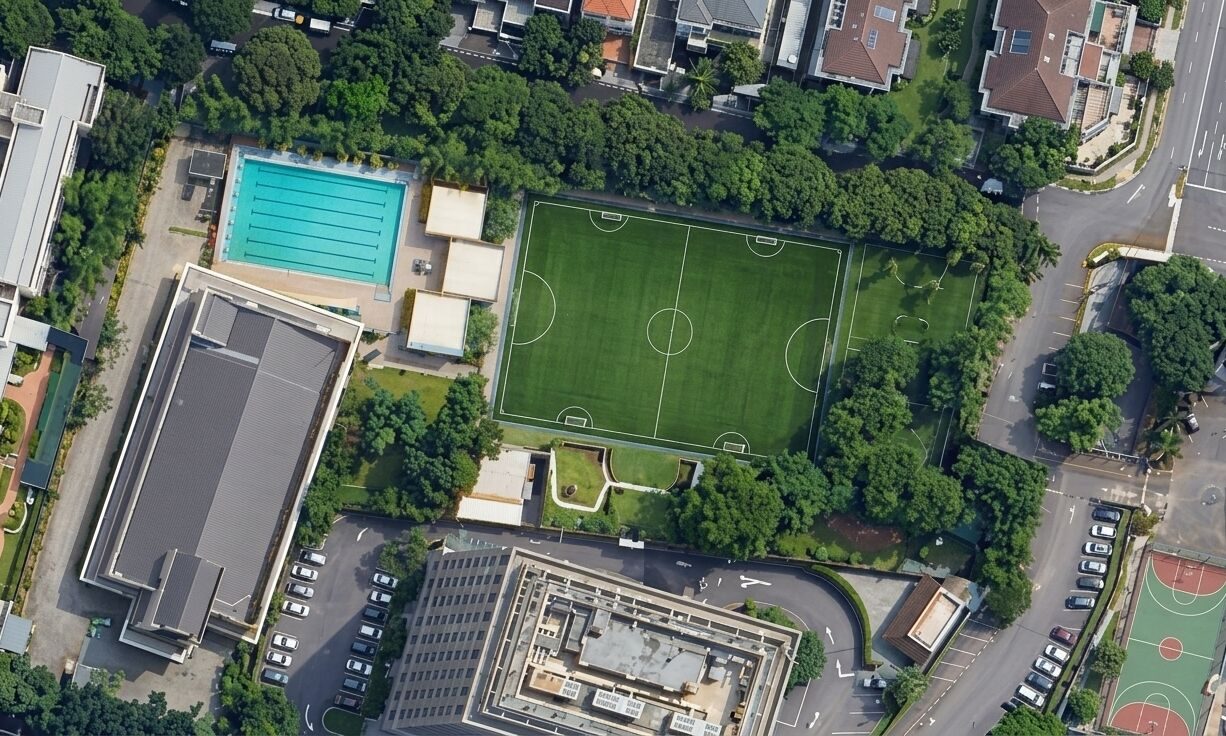
Jakarta with a baby strapped to your chest is a different city. The constraints that shape adult life are traffic, heat and air, and they tighten further around a child who naps at fixed times, needs a clean changing surface, and cannot wear a respirator on a smoggy morning. Most expat and affluent Indonesian families in South Jakarta build the week around three or four anchor places near home, lean heavily on household help, and treat the school run as the day's organising principle long before formal school begins.
This briefing is written for families in Kemang, Cipete, Cilandak, Pondok Indah and the wider South Jakarta corridor with children under five. It pulls together what experienced parents do differently from new arrivals, with hard numbers on the two environmental constraints, a practical map of where daily life happens, and a short list of decisions worth making in the first month rather than the sixth.

Two constraints shape the day
Traffic in South Jakarta is non-linear. A 6 km trip from Pondok Indah to SCBD takes about 20 minutes at 6am and 75 minutes at 5pm, with a sharp tightening around school drop-off and pick-up windows. Parents stop planning in distance and start planning in windows. The standard pattern is to do anything outside the home before 9am or after 7pm, and to treat the school run as the fixed pillar everything else bends around.
Air quality is the constraint most families underestimate. Jakarta's 2024 mean PM2.5 reading was 41.7 micrograms per cubic metre, 8.3 times the WHO annual guideline of 5 micrograms. Bad days in the dry season push past AQI 150, the threshold at which sensitive groups are advised to stay indoors. Greenpeace Indonesia has estimated that around 2,000 low-birth-weight births a year in Jakarta are attributable to PM2.5 exposure.
The practical response is the same in most Pondok Indah households with a baby: a HEPA air purifier in the nursery, IQAir or Nafas installed on a parent's phone, and a habit of checking the morning reading before any pram walk. Outdoor activity is best avoided from 6am to 9am during the dry season, when rush-hour emissions sit thickest at street level.
Where the week happens
The combination of traffic and air pushes daily life indoors and close to home. Most under-five families develop a rotation of three or four anchor places: one premium mall for errands and indoor play, one compound or apartment with a pool and garden, one park used in the cooler windows, and one weekend reset destination outside the city. Pondok Indah Mall is the de facto community hub for South Jakarta. PIM 2 and PIM 3 are the most stroller-friendly, with multiple family rooms offering padded changing tables, private nursing and pumping pods, sinks with hot and cold water, and lifts on every floor.
| Setting | What it offers | South Jakarta anchors |
|---|---|---|
| Premium malls | Air conditioning, baby rooms, indoor play, paediatric clinic, supermarket and café in one stop | Pondok Indah Mall (PIM 1, 2, 3 and Street Gallery), Plaza Senayan, Senayan City, Pacific Place, Ashta, Lotte Avenue |
| Indoor playgrounds | Soft play for crawlers, active play for older toddlers | Pororo Park and SuperPark at PIM, Miniapolis at Pacific Place, Playtopia at Senayan Park, Lollipop's Playland at Senayan City |
| Outdoor parks | An hour of green before it is too hot or too smoggy | Taman Suropati, Taman Menteng and Taman Situ Lembang in Menteng; Hutan Kota GBK in Senayan |
| Compound life | Garden, pool, peer children, secure pavement for prams | Pondok Indah, Kemang Village, Senopati, Permata Hijau |
Mobility with an under-five
The single rule worth absorbing is that Indonesia has no car seat law and ride-hailing drivers do not supply one. Every car journey with an infant or toddler should be in a seat the family owns and has fitted. Specialist operators such as Taxi Bambino offer pre-fitted vehicles for airport runs and longer trips. For day-to-day movement the standard pattern is a private car with a driver, supplemented by the MRT when the journey runs north along the spine and traffic would otherwise win the morning.
| Option | Best use | Caveat for under-fives |
|---|---|---|
| Private car and driver | School run, hospital trips, weekend outings | Fit your own car seat. Indonesian law does not require one; the risk does |
| GrabCar or GoCar | Short errands and evening dinners | Same car-seat gap. Acceptable for short low-speed trips with an older toddler in a parent's lap |
| GoRide or GrabBike | Adults only | Not safe with infants or toddlers under any circumstances |
| Jakarta MRT (Line M1) | Pondok Indah, Fatmawati or Lebak Bulus into SCBD and Bundaran HI in about 20 minutes | Stroller-friendly, lifts at every station, air conditioned, priority seating. The single best way to skip a traffic spine |
| TransJakarta BRT | Cheap air-conditioned buses on dedicated lanes | Priority Pin scheme available for parents and pregnant women. Boarding can be crowded at peak |
| Walking with a pram | Inside malls, compounds and a handful of parks | Pavements outside those settings are broken, blocked by parked motorbikes, and not viable as a daily mode |
The suster economy
Household help is the single biggest lifestyle difference between Jakarta and London, Sydney or Singapore. A live-in suster, the child-focused nanny, earns roughly Rp 3.5 to 5 million a month at the entry level, rising to Rp 6 to 10 million for experienced English-speaking susters working with expat families. Most households also employ a separate housekeeper and a driver. The norm is for susters to focus on the children rather than the home, unless specifically agreed otherwise.
The practical effect for a family with a baby and a toddler is large. Date nights happen. Second pregnancies do not collapse the existing routine. School events do not require a six-person logistics chain. Most families find their suster through school parent networks and personal referrals; agencies such as Kasicare, Nanny Care ID and Jakarta Household Staff cover the rest of the market. The longer guide on helpers and drivers in Jakarta covers contracts, pay norms and cultural expectations.
Paediatric healthcare
Paediatric care is one of the few categories where expat-grade infrastructure sits close to home in South Jakarta. Most international insurers settle directly with RS Pondok Indah and Mayapada. Registering with a hospital and downloading its app before there is a 2am fever is the small piece of admin that separates calm families from panicked ones.
| Provider | Best for | Location |
|---|---|---|
| RS Pondok Indah (RSPI) | Flagship private hospital, full paediatric subspecialties, JCI-accredited, English-speaking | Pondok Indah, Puri Indah, Bintaro |
| Mayapada Hospital | English-speaking doctors, formal partnership with NHG Singapore | Kuningan, Lebak Bulus, Tangerang |
| SOS Medika Klinik | Primary care, vaccinations, travel medicine, 24/7 expat-oriented | Cipete, Kuningan |
| Brawijaya Hospital | Strong on obstetrics and paediatrics, more affordable | Antasari, Saharjo, Duren Tiga |
Two seasonal hazards worth planning around
Rainy season runs roughly November to April. The defining hazard is dengue. South Jakarta logged 428 cases in January to mid-April 2025, with Jagakarsa the worst-affected sub-district. Practical defences for under-fives are unglamorous and they work: DEET (10 percent or above) or picaridin repellent on exposed skin morning and dusk, long sleeves at dawn and dusk, mosquito nets on prams and cots, and weekly elimination of standing water in plant saucers, gutters and air-conditioning drip trays. Sudden high fever in a child during rainy season warrants a same-day visit to RSPI or Mayapada.
Dry season runs June to October and the air gets noticeably worse. A HEPA purifier in the nursery is the highest-leverage piece of kit in the house. KN95 masks work well for parents on red-AQI days; toddler masks rarely fit properly, so staying indoors is the better option. Pram walks are best moved to late afternoon or skipped on the worst days.
Where to shop
International formula such as Aptamil, Friso and S-26 is stocked at Ranch Market, Kemchicks, Grand Lucky and AEON in Cilandak Town Square at roughly 1.3 to 1.8 times home-country prices. Local formula brands (SGM, Bebelac, Lactogen) are sold in every supermarket and minimarket and are materially cheaper. Diapers from Pampers, Huggies and Merries sit alongside MamyPoko, Sweety and Baby Happy at all supermarkets, Watsons and Guardian. Larger items, including prams, cots and car seats, are at Baby Shop Pondok Indah, Mothercare at PIM and Plaza Senayan, and IKEA in Alam Sutera. Tokopedia and Shopee cover almost everything else for next-day delivery.
The five decisions that matter most in the first month
- Living close to the school. A 7 km commute can mean leaving the house at 6:15am with a tired four-year-old. Most families settle in Pondok Indah, Cilandak, Kemang or Bintaro, picked by school catchment rather than neighbourhood character. The Jakarta school commute times guide maps real journey times from each.
- The suster, hired early. Waiting three months loses three months of sleep, exercise and adult conversation.
- Hospital registration before it is needed. Forms filled calmly, app saved. Not at 2am with a fever.
- A real car seat and a HEPA filter. The two purchases that cannot be improvised later.
- A weekly escape. A Bogor day, a Bandung weekend on the Whoosh high-speed train, or a Bali long weekend keeps the family from burning out on indoor air-conditioned sameness.